
Practical AI planning · November 9, 2026
How do you choose the first AI project for your business?
Choose a useful task before you choose a tool.
By Jason Wyatt
If your first AI project starts with a software demo, I'd back up a little.
The demo might be impressive. You still need to decide which piece of work deserves your attention, whether the tool can help with it, and who has to deal with the answer when it gets something wrong.
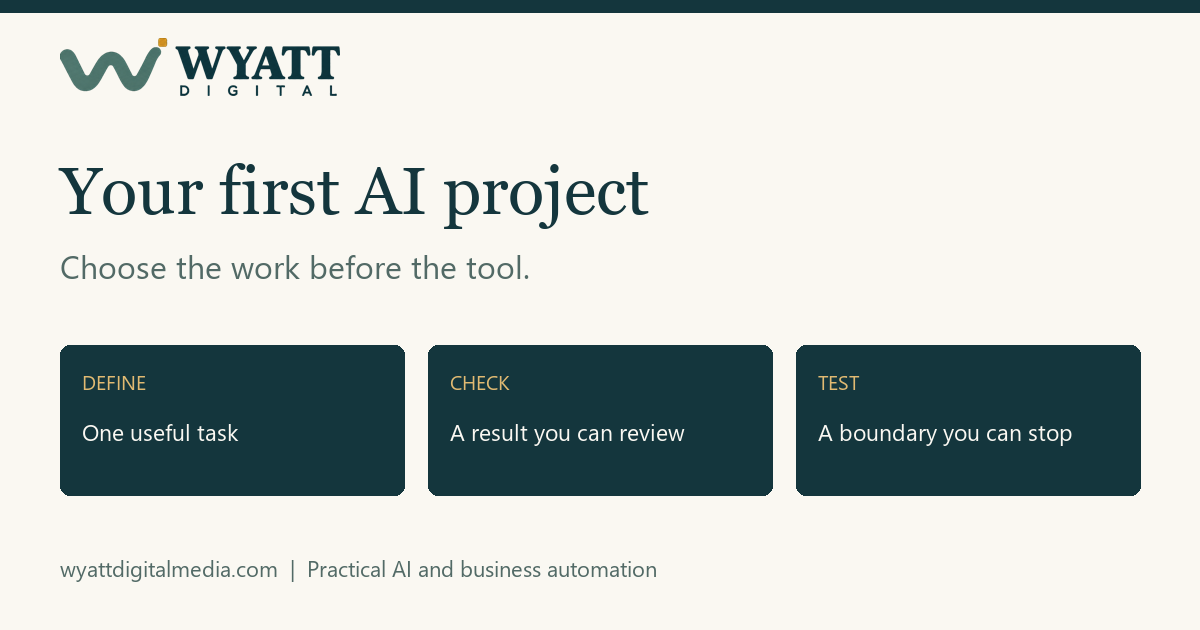
I'd choose a specific task your team can explain, check, and stop. Then I'd compare it with the other jobs competing for the same time and attention.
The short answer: choose a recurring problem with useful inputs, a clear owner, a checkable result, and a manageable consequence if the first attempt is wrong. Decide how you'll measure the work before picking a tool. If a simple rule solves the problem, start there.
1. What job are you actually trying to make easier?
"We need AI in customer service" is too broad to be a first project.
Does your team need help reading incoming requests? Finding information in approved documents? Preparing a draft somebody checks? Those are different jobs, and each one needs its own definition of a useful result.
Write the task as a sentence:
When [specific input] arrives, help [named role] produce [specific output], so they can [next useful action].
Here's a hypothetical example, not a client project:
When a product inquiry arrives by email, help the inside-sales coordinator prepare a short summary of the customer's request and the information still missing, so the assigned salesperson can decide what to ask next.
That is a project you can examine. It has an input, an output, and a person who uses the result. It doesn't authorize the software to promise stock, choose a substitute product, set a price, or send a quote.
If you haven't found a useful task yet, my guide to finding repetitive work gives you a place to start. Here, we're deciding which candidate deserves the first pilot.
2. Does this task need AI, or does it need a clear rule?
Sometimes the useful fix is ordinary automation.
If every inquiry from a particular form should notify the same role, you may need a rule that routes the notification. If the record already contains the required information, you may need a reliable way to move it. Neither task automatically needs a model to interpret anything.
AI becomes a candidate when the work involves interpreting varied language, organizing unstructured information, or preparing a draft that a person can review. That still leaves you with a question: can you check the result well enough to use it?
Consider these illustrative candidates:
| Candidate | What I'd examine first |
|---|---|
| Notify an assigned role when a known form arrives | Can a simple routing rule do the whole job? |
| Summarize a varied email request for staff review | Can the summary be checked against the original message? |
| Answer from an approved internal document set | Are the documents current, and can the reviewer find the supporting passage? |
| Send a final price or approve a product substitution | Who has authority, what information is required, and what happens if the decision is wrong? |
The last row is a much bigger commitment than preparing a summary. I wouldn't bundle them together just because one demo shows both.
You might say, "But Jason, we're supposed to be getting started with AI."
You're supposed to be improving the work. If a routing rule does that, you haven't failed to adopt AI. You've solved a problem.
3. Which candidate has the strongest reason to go first?
I would compare the candidates on the same page instead of letting the most exciting demo win.
Use these questions as a discussion guide. This is my practical selection checklist, not a validated scoring system.
- Useful problem: What delay, repeated effort, or missing information does this remove? Who notices when it happens?
- Usable inputs: Can you get the information the task needs, and do you know which source is current?
- Checkable result: Can a person tell whether the output is accurate and useful?
- Manageable consequence: What can a wrong result cause before a person catches it?
- Clear ownership: Who reviews the work, handles exceptions, and decides whether to continue?
- Reasonable total effort: Can your team support the setup, review, corrections, and ongoing upkeep?
Mark each answer clear, needs work, or unknown, and write a sentence explaining why. A neat total won't rescue a candidate whose essential input is missing.
For example, preparing a request summary might look promising until you discover that the attachments are inaccessible or the person reviewing it has no time to check them. That changes the project.
Work through the unknowns before treating the candidate as ready.
4. Where does the pilot start, and where does it stop?
A small pilot is a limited test of the proposed process. It needs a boundary you can describe without waving your hands.
For the hypothetical inquiry-summary project, I might start with an approved set of redacted historical requests. Staff could compare the draft summary with the source before it touches a live customer conversation.
The boundary would be specific:
- One kind of incoming request.
- One agreed source of information.
- One output format.
- One assigned reviewer and a backup.
- No automatic customer replies or changes to commercial records.
- A documented way to stop the test and return to the existing process.
Those are proposed boundaries for this example. Your actual test may need different ones.
Before providing business information to a tool, check which information is approved for that use and whether the selected service and configuration fit your requirements. Don't upload real records merely because they're convenient examples.
If you're working across locations, keep the first boundary small enough that you know which team's procedures apply. A branch that handles requests differently may need another test. More locations means more conditions to understand, even when the software looks the same.
For a more formal reference, NIST's voluntary AI Risk Management Framework addresses trustworthiness considerations through the design, use, and evaluation of AI systems. The checklist here is a practical starting point, not a claim of certification or compliance with that framework.
5. What would you put in the first project brief?
You don't need a stack of slides to define the first test. You do need agreement about the job.
Here's a brief I would complete before discussing a build:
| Decision | What to write down |
|---|---|
| Problem | The specific delay, repeated work, or information gap |
| User and owner | Who uses the result, who reviews it, and who covers exceptions |
| Input | The approved source and any information that must be excluded |
| Output | What the result contains and what it must never invent |
| Boundary | Which requests, team, location, and actions are in scope |
| Review | How a person checks the result and records a correction |
| Baseline | How the current process performs on comparable work |
| Success and stop rules | What would justify continuing, pausing, or ending the pilot |
| Review date | When the owner will examine the evidence and decide the next step |
For our example, "good summary" needs more detail. The brief might require the customer's requested items, quantities as stated, timing as stated, and a list of missing details. It would also require the reviewer to open the original inquiry.
If the request doesn't contain a quantity, the output should say that the quantity is missing. It shouldn't fill the blank with something that sounds reasonable.
That one detail gives you something concrete to test.
6. How will you measure whether the pilot helped?
Measure the whole task your team has to perform.
A draft produced quickly may still require enough checking and correction to make the overall job slower. Record that review effort instead of hiding it outside the comparison.
For comparable cases, track:
- Time spent preparing the result.
- Time spent reviewing and correcting it.
- Missing or incorrect information.
- Cases that need escalation or cannot be completed.
- Whether the person using the result can take the intended next step.
- Setup and upkeep effort separately from routine processing.
Agree on the conditions for success before looking at the results. You might require an approved level of completeness, no invented commercial details, and an improvement in total handling effort. Those conditions belong to your business and your task. I can't responsibly supply a universal percentage that makes every pilot worthwhile.
Keep the counts and the original cases behind any summary. If the pilot only covers easy requests, say so. It doesn't establish that the process will handle an unusual attachment or an ambiguous request from another location.
A time estimate isn't automatically a financial saving, and a useful draft isn't automatically a sale. Report what you actually observed.
7. What should you test before expanding it?
I'd test the ordinary case and the cases that make the ordinary process uncomfortable.
For the hypothetical request-summary pilot, that could include:
- A straightforward request with all the agreed information.
- A request with no quantity or required timing.
- An email that refers to an attachment the tool cannot read.
- Conflicting details in the message and attachment.
- A request outside the agreed scope.
- A case the assigned reviewer needs to hand to the backup.
Write down the expected response for each case before running it. "Flag the missing attachment" is an expected response. "Make something up so the summary looks finished" is not.
Then check the handoff. Does the reviewer see the original information? Can they correct the draft? Can they pause the process when a pattern of errors appears? Does somebody own that decision?
Expand only after you've examined the evidence against the conditions in the brief. Keeping the same scope while you fix a weakness is a reasonable decision. Ending a pilot can be useful too, if it tells you the task isn't a good fit.
So which project would I choose first?
I'd choose the candidate with a useful problem, usable inputs, a result somebody can check, and an owner who can run a limited test. If those pieces aren't there, I'd work on them before adding software.
That might be a request summary for a distributor, a draft of an internal handoff for a service business, or a repeatable rule that doesn't need AI at all. The process determines the choice.
Pick one candidate and write the brief. That's enough to have a useful conversation about what should happen next.
Want help choosing that first project? Book a conversation. Bring the task you're considering, the tools already involved, and the part that's giving your team trouble.
I'll see you on the road.