
Customer request handoffs · November 11, 2026
Who should own a customer request across departments or locations?
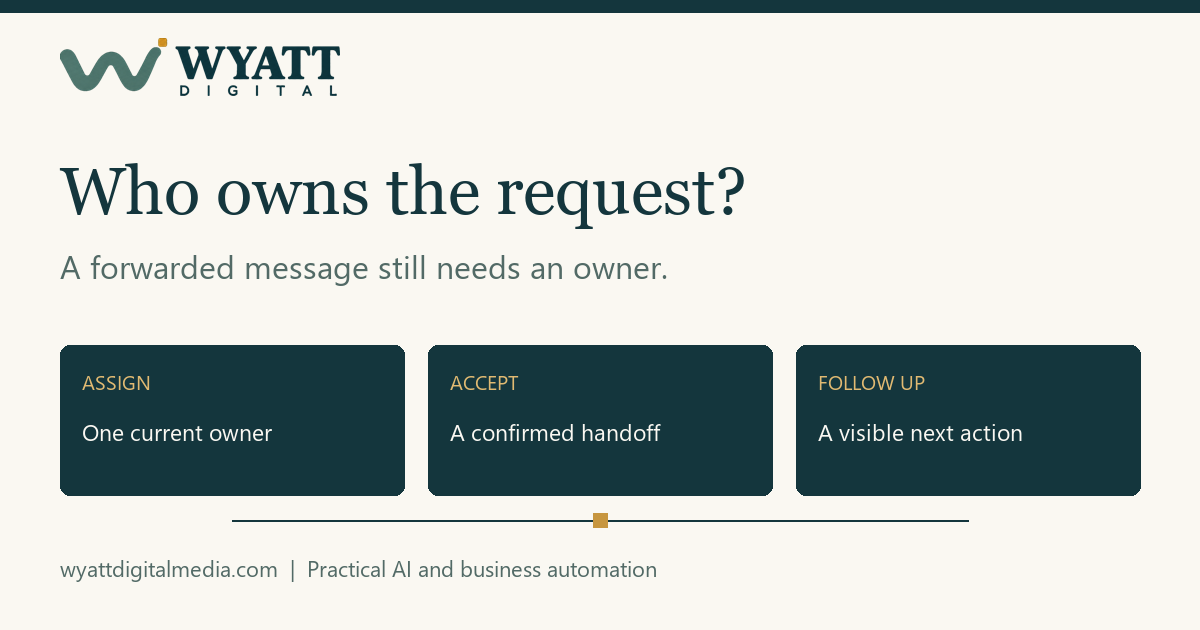
Keep one owner until the next person accepts the handoff.
By Jason Wyatt
When a customer request lands in two inboxes, who owes the customer an answer?
If your answer is "somebody in sales," I'd keep asking. Which person is watching it today? What happens when that person needs information from another branch? And who checks whether the customer ever got a useful answer?
My short answer: give each open request one current owner, a defined next action, and a backup. Keep that owner in place until the next person accepts the handoff. A forwarded message by itself doesn't tell you that anybody has taken responsibility.
This applies whether you're running a service office, a supply counter, or several locations. AI can help prepare information, but your team still needs to agree on who does what. I'd work through that agreement before adding another notification.
Here's the process I'd put on one page.
1. What does owning a request actually mean?
The owner is the person responsible for moving the request to its next useful step and keeping the customer informed. They don't have to perform every task themselves.
A salesperson can own a product inquiry while someone else checks stock. An office coordinator can own a service question while a technician checks the job notes. Waiting for a colleague's answer is part of the work, and the request still needs somebody watching it.
I'd separate three responsibilities:
| Responsibility | What that person does |
|---|---|
| Current request owner | Tracks the next action, follows up on missing information, and keeps the customer informed |
| Specialist or decision maker | Supplies information or makes a decision within their actual authority |
| Backup or supervisor | Takes over when coverage fails or the request needs escalation |
In a small business, one person may hold all three roles. That's fine. Write down the arrangement anyway, because "we all know how it works" tends to get less convincing when somebody takes a day off.
Ownership also needs authority. If the coordinator can't approve a refund, assigning them the request doesn't give them permission to approve one. Give them a clear route to the person who can decide.
2. Where should the team keep the working record?
Choose one place your team will check for the current owner, status, and next step. That might be an existing customer-management system, a service desk, or a carefully managed shared register.
I wouldn't buy software just to avoid making that decision. If your current system can support the process, start by defining how you'll use it. If it can't, identify the missing function before shopping.
For each request, I want the record to answer these questions:
- Who is the customer, and which contact method is appropriate?
- What do they need, in their own words?
- Who owns the request now, and who is the backup?
- What is the next action, and when will somebody check it?
- Which department or location is involved?
- What has already been promised to the customer?
- Where can an authorized person find the original message and relevant details?
Keep the information necessary for the work and follow your business's access rules. A shared record doesn't mean every employee should see every attachment or account detail.
Then make the owner visible. A long email chain with three versions of the next step is a poor substitute for one current answer.
3. When is a handoff actually complete?
My recommended rule is simple: the sending owner keeps responsibility until the receiving person accepts it through the process your team agreed to use.
That acceptance could be a reassignment confirmed in your existing system or an explicit acknowledgment recorded with the request. The mechanism matters less than whether both people can tell who owns it afterward.
I would use these states:
| State | Who owns the request? | What happens next? |
|---|---|---|
| Assigned | The named current owner | Work the next action or ask for missing information |
| Waiting for specialist input | The current owner still owns it | Check the agreed review time and update the customer when needed |
| Transfer requested | The sending owner still owns it | Receiving person accepts or declines with a reason |
| Transfer accepted | The receiving person becomes the owner | Record the new next action and customer expectation |
| Closed | Final owner is recorded | Keep the outcome and any agreed reopening route |
These are proposed working states, not a claim about features in a particular platform. Check what your system actually supports before relying on an automatic assignment.
"But Jason, isn't that extra work?"
Some of it is. Compare that effort with reopening the same conversation tomorrow because nobody knows whether the other branch handled it. Start with the requests that already cause confusion, and keep the acceptance step short.
4. What would this look like across two branches?
Here's a hypothetical supply-business example, not a client project.
A customer asks the North branch about an item needed for a job. The North coordinator takes ownership, confirms what the customer is asking for, and asks the South branch to check the relevant information.
The South branch's involvement doesn't automatically transfer ownership. The North coordinator is still responsible for following up and explaining the next step to the customer.
Suppose the customer then asks to work directly with South. Now a transfer may make sense. Before the owner changes, I'd want a note like this:
Request: Customer wants confirmation of the specified item and collection arrangements.
Current owner: North coordinator.
Proposed receiving owner: South coordinator on duty.
Information passed: Original request, exact item details supplied by the customer, outstanding questions, and any contact preference already agreed.
Pending decision: South must verify availability and collection details before making a promise.
Acceptance: Receiving coordinator confirms ownership and records the next action. North retains ownership until that happens.
No invented stock status. No assumed delivery promise. The person checking the actual information makes the appropriate decision.
If South can't accept the request, North needs a fallback. That might mean asking a supervisor to assign coverage or telling the customer when an update can realistically be provided. Choose the response around your real staffing and authority.
5. What happens when the owner is away or nobody accepts?
Give the process a backup before you need one.
For each role, agree on the staffed hours, the backup, and the point at which an unfinished request gets reviewed. I can't give you one response-time promise that fits every business. Your customer commitments need to match what your team can actually support.
A review time is an internal reminder to examine the request. A promised customer response time is a commitment to the customer. Keep the two distinct and record any commitment you make.
I'd define what happens in these situations:
- Owner absent: The designated backup checks the open work and confirms which requests they have taken.
- Transfer declined: The sending owner records the reason and chooses another approved route.
- No acceptance: The request stays with the sending owner and appears in the next review of unfinished work.
- Duplicate request: Staff connect the records, confirm the current owner, and avoid sending conflicting answers.
- Customer changes the request: The owner updates the next action and checks whether a different person needs to decide.
- Business closed: Use the approved after-hours process without promising that an unavailable employee is already working on it.
A supervisor should be able to find requests that are waiting without having to ask every employee separately. If your only way to discover unfinished work is to hear from an annoyed customer, you've got a gap worth fixing.
6. Where could AI or automation help?
Once you agree on the process, look for a bounded task inside it.
An AI-assisted draft could summarize the original request for a person to check. An ordinary rule could remind the current owner that a review time has arrived. A system might suggest a department based on approved routing information, with an employee confirming the destination.
Those are possible tasks to evaluate. They aren't promises that your current tools provide those functions or that the connections are already configured.
I would keep the important boundaries explicit: who can send a customer reply, who can approve a commercial decision, and who can accept ownership. A generated summary saying "sent to South" doesn't prove that South received or accepted anything.
Keep the original message available to the authorized reviewer. If the draft leaves out a quantity, misreads a location, or adds a promise, somebody needs to catch it before it guides the next action.
For broader AI planning, NIST's voluntary AI Risk Management Framework is a useful reference for considering trustworthiness across the design, use, and evaluation of an AI system. The ownership process here is my practical recommendation, not a certification or compliance claim.
If you're still deciding which task deserves a test, use the first business AI project guide. For a live caller trying to reach a person, the voice-agent handoff guide covers that separate phone journey.
7. How would you test the ownership process?
I'd start with a few made-up requests and the people who would actually handle them. Walk each request through the existing tools without contacting a real customer or changing a live order.
Test a normal request, a transfer that gets accepted, a transfer that gets declined, an absent owner, and a customer who contacts two locations about the same issue. Add a missing attachment or an unclear location if those are realistic problems for your team.
For every case, ask each person to identify the current owner, the next action, and the fallback. If they give different answers, fix the rule or the record and run the case again.
Before a limited live trial, choose what you'll examine. I would record requests with no assigned owner, transfers waiting for acceptance, missed review times, duplicate replies, and cases reopened because the first answer didn't finish the job. Look at the underlying requests along with the counts.
An increase in reminders sent doesn't establish that more customers got an answer. Check the outcome your process is supposed to produce, and be honest if the sample is too small to tell you much.
What should you put in place first?
Give one type of customer request a current owner, a next action, a review time, and a backup. Agree on how somebody accepts a transfer and how the team handles it when they don't.
That's enough to start examining a real process. You can add software around an agreement your team understands, and you can test whether the software follows that agreement.
Heck, another inbox is easy. Knowing who owes the answer takes a little more thought.
Want help mapping a request that keeps bouncing between people? Book a conversation. Bring one example of the route it takes now and where it usually gets stuck. We'll use that to discuss the next useful step.
I'll see you on the road.