
Automation measurement · November 18, 2026
How should you measure staff time saved by an office automation?
Count the whole task, including the work people still do.
By Jason Wyatt
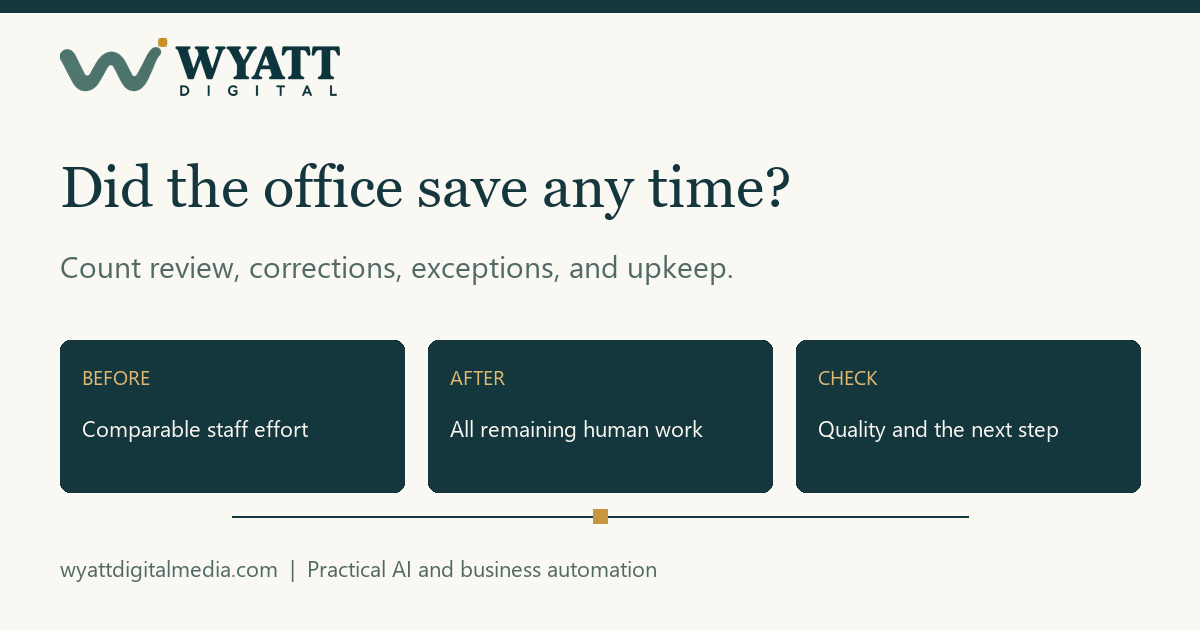
Did the automation save your office an hour, or did it move an hour of work onto the person who checks its mistakes?
That's the question I'd answer before putting a time-saved number on a report. A task can run faster on a screen while your team spends the afternoon checking the output, fixing exceptions, and finding the records that never made it through.
To measure staff time saved, compare the human time needed to complete the same kind of work before and after the change. Include preparation, review, corrections, exception handling, and recurring upkeep. Keep waiting time, one-time setup, and actual business outcomes in separate columns.
Then check that the work still meets the standard you agreed on. Finishing faster doesn't help much if the next person has to do it again.
I'll walk you through a practical measurement plan and a fictional office example. The numbers below are arithmetic to show the method. They're not Wyatt Digital client results or a prediction for your business.
1. Where does the task actually start and finish?
Pick one task and give it a finish line.
For a supply office, that might be taking a complete quote request and preparing a draft that a person can approve. For a service office, it might be getting a new inquiry into the right person's work queue with the required details attached.
“Process the email” is too loose. Does that mean open it, classify it, copy the information, create the record, or finish the customer's request?
Write down what has to be true at the end. In the quote example, the draft may need the correct account, requested items, delivery location, and a visible list of unanswered questions. It still needs approval before anything goes to the customer.
Now list everybody who touches the task. If the counter person saves five minutes and the branch manager spends five minutes fixing the draft, that belongs in the same measurement.
Count the work across the handoff. Otherwise, you can make one person's numbers look wonderful by making somebody else's day worse.
If you're still choosing which task to try, use the guide to choosing your first AI project. Start with a clear job before measuring a broad “AI initiative.”
2. What should go into the before measurement?
Your baseline is the record of how the work happens before the change. It needs to include the ordinary mess, because that's the work the new process has to handle.
For each observed request, record the task type, the people involved, their active minutes, the result, and any correction or unresolved issue. Use a reference number rather than copying customer details into a measurement sheet.
Active minutes mean time a person actually spends doing the work. Include opening and preparing the information, looking something up, entering it, checking it, and correcting it. If two people each spend three minutes, that's six staff minutes even if they work at the same time.
Keep the waiting separate. An unanswered approval request sitting overnight affects the customer experience, but it isn't eight hours of active staff effort.
| Record separately | What it tells you |
|---|---|
| Active staff time | How much human work the task uses |
| Elapsed time from start to finish | How long the request takes to get through |
| Completed and unresolved counts | Whether work is finishing or accumulating |
| Corrections and exceptions | Where extra work or quality problems occur |
| Task type or complexity | Whether the before and after work is comparable |
Choose an observation window that includes the normal mix of work. If Monday brings different requests than Friday, don't quietly compare the busiest Monday to the easiest Friday and call the difference an automation result.
There isn't one magic sample size for every office. Record how many cases you observed, the dates, and what was missing from that period. A small pilot gives you a starting reading with limits.
Be honest about those limits.
3. What human work remains after the automation runs?
Now measure the changed process with the same start, finish, and quality standard.
The automated step might take seconds. The person still has to collect the input, review the result, handle an exception, or approve the next action. Count that time where it happens.
I'd include these categories:
- Preparation: cleaning up the input or finding information the system needs.
- Routine handling and review: checking the output and completing the ordinary human steps.
- Extra correction and exception work: repairing mistakes or handling cases outside the ordinary path.
- Recurring upkeep: checking failures, maintaining the rules, and reconciling missing work.
Define those categories so you don't count the same minutes twice. If routine handling already includes a correction, don't add it again under exceptions.
Record requests the automation skips as well as the ones it handles. You need to know how much of the incoming work the new process actually covers.
And keep unresolved cases visible. A fast process with a growing pile of unfinished requests has handed you an unfinished measurement. Don't assign zero future effort to the pile because nobody has fixed it yet.
For the record matching and failure checks behind that process, see the business system connection checklist.
4. What does the calculation look like with real categories?
Let's use a fictional weekly example with 120 comparable requests, all completed and checked against the same acceptance standard.
Before the change, the office spends an average of six active staff minutes per request, including its existing checks and corrections. That is 720 staff minutes for the week.
After the change, routine preparation, handling, and review take three minutes per request. Twenty of those requests also need three extra minutes of exception work each. The office spends another 30 minutes checking the process and maintaining its rules.
| Fictional weekly calculation | Staff minutes |
|---|---|
| Before: 120 requests × 6 minutes | 720 |
| After: routine work for 120 requests × 3 minutes | 360 |
| After: extra exception work for 20 requests × 3 minutes | 60 |
| After: recurring process checks and upkeep | 30 |
| Total after the change | 450 |
| Difference: 720 − 450 | 270 |
The observed difference in this made-up example is 270 staff minutes, or 4.5 hours for the week.
Counting only the routine step would have produced a six-hour claim. The extra work changes the answer. That's why I want it on the sheet.
A useful formula is:
Staff time released = comparable before-work minutes − all recurring after-work minutes.
That formula assumes the comparison covers the same quantity and kind of accepted work. It doesn't make a poor comparison reliable just because the subtraction is correct.
If the after period contains a different number of requests, compare minutes per completed comparable request as well as total workload. Then report the actual volume alongside it. Keep unresolved work and process-wide upkeep visible so they don't disappear inside a tidy average.
5. How do you know the improvement isn't a change in the work?
You might say, “But Jason, we don't get the same requests every week.”
Exactly. So write down what changed instead of pretending you ran a laboratory.
Separate straightforward requests from requests with missing information, unusual items, or multiple locations. Compare similar groups where you can. If the new process handles only the easy cases, say so, and keep the rest of the workload in the office total.
Look at the typical case and the difficult cases. Averages can hide one request that takes an hour to untangle. Note the exceptions that consume most of the correction time and decide whether they need a rule change or a human path.
Other changes belong in the record too: a new employee, different staffing, quieter demand, a revised form, training, or a policy change. If several things changed together, you can report the observed difference without crediting all of it to the automation.
Where it's practical, compare a limited pilot with a similar unchanged process during the same period. Don't send duplicate customer messages or create duplicate orders to manufacture a comparison.
If there's no sensible comparison group, label the reading before-and-after and explain the limits. “We observed less active handling time in this period” is a useful statement. You don't need to dress it up as proof you don't have.
6. What quality checks belong beside the time number?
Agree on the standard before you see the result.
For the fictional quote-draft task, that might include correct account and delivery details, required information present, unanswered questions flagged, and a person approving the draft before it leaves the office.
Measure whether the output passes that standard and what happens after approval. If somebody finds the error downstream, that correction still belongs to the process.
I'd put the time reading beside:
- The number of eligible requests and how many the new process actually handled.
- The number completed, unresolved, and sent back for correction.
- The errors that mattered to the next person or the customer.
- The review and exception minutes needed to get acceptable work.
- Any missed deadline or unintended action that requires attention.
For AI-assisted work, a broader resource is NIST's AI Risk Management Framework, which is voluntary guidance for considering trustworthiness through the design, use, and evaluation of AI systems. The time worksheet here is my practical measurement approach, not a NIST formula or certification.
And keep operational outcomes separate from the time claim. Faster quote preparation doesn't by itself prove more sales. A phone-link click doesn't prove a completed call. A booking doesn't prove a qualified opportunity.
If you're evaluating the HVAC follow-up path specifically, the five-number workflow guide covers response, conversations, follow-through, appointments, and attendance. Those measures answer a different question from staff effort.
7. What do you do with setup time and the hours you release?
Keep one-time setup and training on a separate line.
In our fictional example, suppose setup and initial training take nine staff hours. The weekly operating comparison still shows a 4.5-hour difference, and the initial nine hours still happened. Both belong in the decision.
Report recurring effort and one-time effort separately, then show their combined effect over the period you're actually reviewing. Don't spread an optimistic weekly estimate across a year and present it as a result you've already earned.
Now ask what happens to the released time. Does the counter person get through a backlog? Does the office answer requests sooner? Does somebody leave closer to their scheduled finish time?
Record the intended use and check it. Time released is capacity the team may be able to use. It isn't automatically a payroll reduction, cash saving, or additional revenue.
You can have a worthwhile improvement without inventing a dollar figure.
Choose the next review date and the conditions for expanding, adjusting, or pausing the process. If the pilot is still mostly training and troubleshooting, say the steady operating picture isn't clear yet.
So what would I put on your weekly sheet?
I'd keep one page with the dates, task boundary, acceptance standard, task mix, request counts, staff minutes before and after, exceptions, upkeep, setup time, and the next review date.
Then I'd add a short decision: continue the limited trial, adjust a specific problem, expand cautiously, or pause. Include the reason and the evidence you're missing.
The point is to find out whether your office has less work to do, acceptable work coming out, and a useful place for any time you've released. A dashboard number can't answer all three by itself.
If you're considering an office automation and want to know what to measure first, book a conversation. Bring one task and a rough picture of who touches it, and we can start with the work you're actually doing.
I'll see you on the road.