
Duplicate HVAC leads · November 27, 2026
What should an HVAC office do when the same lead arrives twice?
Preserve the inquiry without repeating the work.
By Jason Wyatt
A homeowner fills out your estimate form, waits a little while, and then calls the office. Does your system see one customer request or two new leads?
If both entries start their own follow-up, the customer could hear from two people, receive two sets of messages, or get asked to book an appointment they've already booked. The office gets more records to sort through without getting another opportunity.
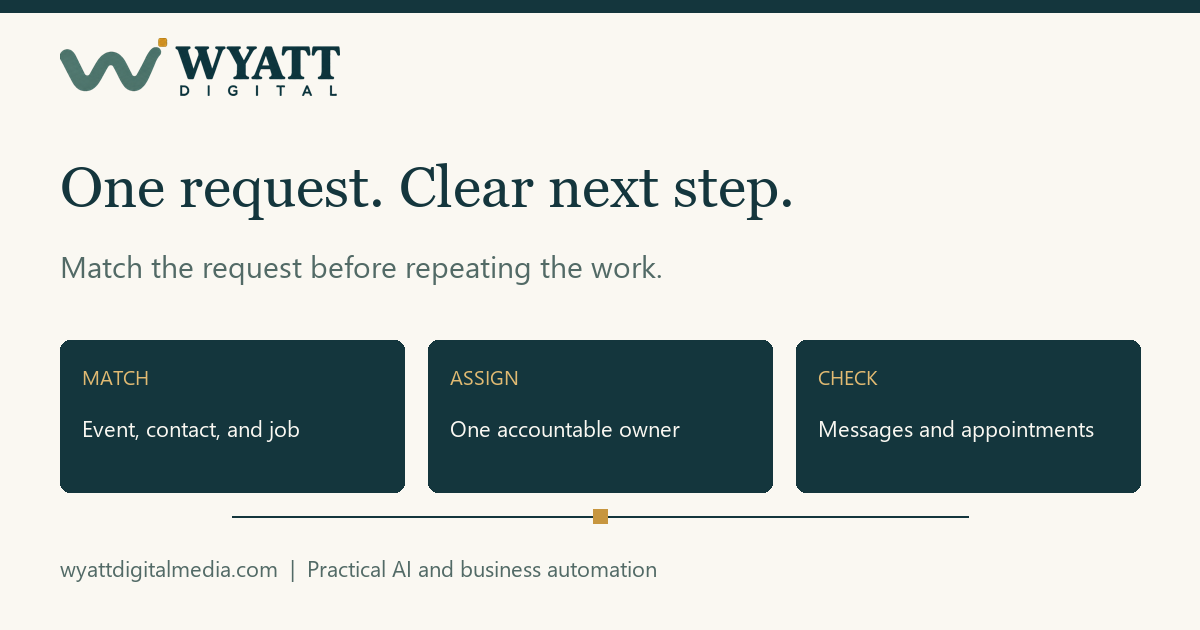
When a possible duplicate HVAC lead arrives, compare it with the existing request before starting another follow-up. Establish whether it's the same event arriving again, another inquiry about the same job, or genuinely different work. Keep the new information, give the request one accountable owner, and check its current appointment and contact status before releasing the next action.
Don't start by deleting something.
I'd start by making sure the office can still see what the homeowner needs. Here's how I'd organize that decision without assuming your current CRM already handles it.
1. Is this a repeated event, a repeated inquiry, or a new job?
Those are different situations, and they need different decisions.
A repeated event is the same system notification arriving again. A repeated inquiry is a person contacting you again about work already in progress. A new job might involve the same customer and phone number but another property, another system, or a separate service need.
Sorting only by a phone number can miss that distinction.
| What arrives | What the office should establish |
|---|---|
| The same form event appears again | Whether the original event was already processed |
| A form is followed by a call about that estimate | Whether both belong to the same active request |
| Two people contact you about one household's job | Who the contacts are and which request they are discussing |
| One customer asks about another property | Whether this is separate work under the same customer |
| An old customer returns with a new problem | Whether an earlier closed request should stay closed |
I'd describe these cases in the workflow instructions before choosing a matching rule. Otherwise, “remove duplicates” can become a broad instruction to combine things that merely look alike.
A customer record and a service request also serve different purposes. One person can have more than one legitimate job. One job can involve more than one person.
Give both facts a place to live.
2. What should you compare before calling it a duplicate?
Use the strongest relevant references your process actually provides.
For a repeated system event, that may be the source's event or submission identifier. For a customer inquiry, the office may need the customer reference, service location, active request, description of the work, and previous conversation.
A matching name or phone number is a clue. It doesn't settle every case.
Write down which combinations support a confident match and which ones need a person. Also define the period the rule considers. A request received during an active estimate conversation deserves a different review from an inquiry received long after that work was closed.
There's no useful universal number of minutes that makes every HVAC inquiry a duplicate.
Preserve the original source and receipt information when you attach a later inquiry to existing work. If a call adds a gate code, corrected address, or different service need, that information must reach the person handling the job. Keep it within your normal access and record-handling rules.
Don't let an older form overwrite a newer correction merely because it finishes processing later.
If several systems are involved, the business system connection checklist helps define matching references and which source controls each field.
3. Who owns the request while the records are being checked?
A possible duplicate needs an owner just as much as a brand-new inquiry does.
I'd have the office identify the existing request owner and put the new information where that person can see it. If no one has accepted the work, route the exception to a named person or queue with a backup and a review point.
“Duplicate” should describe the record decision. It shouldn't mean “nobody needs to respond.”
Check whether the latest inquiry changes the priority or the customer's question. A person who calls after submitting a form may be asking for confirmation, adding information, or reporting that the situation has changed. Route that through your existing service and urgent-request procedures.
Now decide which outbound actions wait during review. You may need to hold a second generic introduction while the assigned person checks the conversation. That hold should stay visible, and it should have someone responsible for resolving it.
Avoid pausing every kind of communication without looking at what it does. An unwanted second sales message and an expected appointment update are different actions.
For a fuller handoff rule between office staff or locations, use the customer-request ownership guide. The existing request should have one accountable owner even when several people contribute to it.
4. What should happen to messages and appointments?
Before another follow-up starts, look at the request as it stands now.
Has somebody already answered? Is an appointment booked? Did the customer cancel, ask a new question, or tell you to stop contacting them? Did the first message send, fail, or remain in an uncertain state?
A second record shouldn't reset those facts.
I'd define which updates are shared across records linked to the same request, which information remains specific to a contact, and who resolves a conflict. Check the actual system behavior rather than assuming that linking or merging records carries every status with it.
| Current situation | What needs checking before the next action |
|---|---|
| Appointment already exists | Whether the proposed booking is the same visit or separate work |
| Office is in an active conversation | Whether another automated introduction is still useful |
| Customer supplied a correction | Which record and queued message need updating |
| Contact restriction is present | Whether the proposed channel and action remain permitted |
| Previous message has an uncertain outcome | What happened before anyone tries again |
Keep contact restrictions intact. Combining records or receiving another inquiry should not automatically erase them or restart a stopped sequence. Have the appropriate person resolve unclear cases using your established process.
Also check appointment creation separately from message sending. Stopping a duplicate text doesn't prove the system won't create a second visit.
For the complete first-response and follow-up path, the HVAC lead follow-up guide shows the broader workflow. The failed follow-up guide covers uncertain delivery and recovery in more detail.
5. What if the same system notification arrives more than once?
This is a useful question for whoever builds or maintains the connection.
Ask how the process recognizes an event it has already handled and how it avoids repeating the same customer-facing action. A record saying “we received this” and a record saying “we completed the intended action” may describe different stages.
The important business question is whether repeating the input repeats the text, task, or booking.
As one provider-specific example, Stripe's webhook documentation explains that its endpoints can receive the same event more than once and describes tracking processed event identifiers to avoid processing those events again. That's guidance for Stripe events. It doesn't establish what your form, CRM, or booking connection does.
For your own setup, have the maintainer explain how it handles an exact repeat, a failure partway through, and two near-simultaneous inquiries. Two processes can both look for existing work before either one has finished creating it, so a simple “search first” rule needs a realistic test.
You don't need to choose the technical implementation from an article. You do need a demonstrated answer to “what happens the second time?”
If the tool can't reliably make the distinction your process needs, keep the uncertain case with a person and narrow the automated action.
6. What would this look like at the front desk?
Here's a fictional example.
At 8:10 AM, a homeowner submits a replacement-estimate inquiry. At 8:14, the homeowner calls and explains that the estimate is for a rental property rather than the mailing address in the earlier record. The office has already started a conversation.
A weak rule sees the same phone number and discards the second entry.
Another weak rule treats the call as a fresh opportunity and starts the introduction again.
I'd want the office to connect the inquiries to the same estimate request, preserve the call's source and notes, correct the service location through the approved process, and make the update visible to the request owner. Then the owner checks any message or appointment that relied on the earlier address.
Now change the example. The homeowner says they also need service at their own home.
That may be a separate job. The same phone number doesn't turn it into unwanted repetition.
You might say, “But Jason, isn't this making a simple cleanup job complicated?”
The work was already there. A merge button just makes it look smaller.
Keep the decision small enough for the office to make: same event, same request with new information, separate work, or uncertain. Route the uncertain case, preserve its history, and give it a next step.
7. How should you test the duplicate-lead rules?
Use fictional or approved test records in an environment that won't contact real customers or create real appointments.
I'd ask the person responsible for the workflow to demonstrate these cases:
- Submit the exact same event again.
- Send two inquiries about the same job through different channels.
- Submit two legitimate jobs using the same contact information.
- Let a second household contact inquire about the existing job.
- Deliver an older inquiry after a newer correction.
- Repeat an inquiry after an appointment is already booked.
- Introduce a contact restriction before the second inquiry arrives.
- Start two test inquiries close enough together to expose a timing conflict.
- Interrupt processing after a task is created but before the workflow records completion.
For each case, check the customer record, active request, owner, conversation, pending messages, and appointments. Record what happened and the rule that should have controlled it.
A tidy contact list isn't the whole test.
If records are merged, check what happens to history, attachments, source information, restrictions, and linked work. Use your platform's documented controls, keep the appropriate recovery record, and have an authorized person handle any destructive cleanup. Don't experiment by deleting live leads.
Write the accepted behavior into the automation handoff documentation so the next person knows how to handle the exception.
So what should the office count?
Keep incoming inquiries separate from distinct customer requests.
A second form or call is another contact event. It may contain useful new information, but it doesn't automatically establish another qualified opportunity, appointment, or completed job.
I'd keep these measures separate in the weekly review:
- Incoming inquiries by source.
- Possible duplicates reviewed.
- Distinct requests confirmed.
- Requests waiting for an owner or missing information.
- Appointments and qualified opportunities verified from their own records.
- Duplicate messages or appointments that actually occurred.
Define the categories and the unresolved cases before comparing totals. Otherwise, a change in record-cleanup rules can look like a change in demand.
The office needs to preserve the customer's information, avoid repeating an unnecessary action, and keep the real work moving. That takes a clear matching rule, an accountable owner, and a tested next step.
If the same lead is starting several conversations in your office, Book a Lead Conversion Audit. Bring one example from the first inquiry through the messages and appointment, and we can start with the part that's getting repeated.
I'll see you on the road.